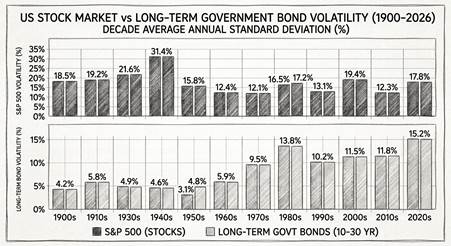
This is an eternal question on any investment forum. While there’s no one-size-fits-all answer, for individual investors, equities remain the ideal choice for long-term wealth compounding. Public consensus generally views bonds as safer than stocks. However, investors who choose bonds out of fear of price volatility often end up missing out on substantial returns. Sure, in certain years, the fixed yield provided by a bond may outpace inflation and offer satisfactory returns. But the longer a bond’s maturity, the more sensitive it is to shifts in interest rates. When interest rates rise, investors ditch older bonds for newly issued ones with higher yields, driving down the prices of the former. Conversely, in a falling rate environment, bond prices rise. Either way, safety-seeking investors primary place their capital into bonds out of fear of market fluctuations. Yet, history shows that during certain periods, long-term bonds can exhibit volatility on par with the stock market itself. This begs the question: in search of safety, is taking refuge in bonds really worth it for the average investor? As seen in the chart below across a decade-by-decade comparison, bond volatility rose significantly starting in the 1970s. While it still doesn’t quite match that of equities, the massive return premium in favor of stocks makes you wonder: why tolerate the volatility of low-yielding, long-term bonds when enduring just slightly higher fluctuations earns you significantly greater returns?”
We need to look at this question from a different angle. If we call ourselves investors, bonds should be viewed as a secondary option—a place to generate satisfactory short-term returns on cash we plan to use within a few years, whether for personal expenses or for future deployments into the stock market (at least preserving its purchasing power against inflation). Therefore, if you do buy bonds, you should strictly focus on short-duration debt and Treasury bills. Many legendary investors advocate this approach, including Warren Buffett—and his stance is certainly worth listening to. Buffett famously recommends putting 90% of one’s capital into a low-cost S&P 500 index ETF and the remaining 10% into short-term government bonds, effectively T-bills. Similarly, in his book The Single Best Investment, Lowell Miller explicitly urges investors to say goodbye to bonds and embrace the world of equities and fluctuating prices. In other words, as an investor, thinking long-term and putting the vast majority of your money into stocks is essential if you want to achieve meaningful returns as a retail investor. Leave the fine-tuning of bond portfolios to large institutions. From a retail investor’s perspective, putting your hard-earned money into long-term bonds is, frankly, a bad move – just as Miller suggests. And it’s hard to argue with him.
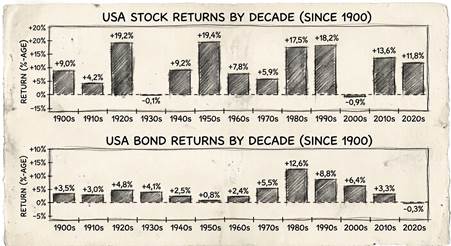
The chart above clearly illustrates the substantial yield advantage in favor of equities, reinforcing the argument that long-term investors belong in the stock market. Over the course of the 20th century, bonds only outperformed during major crises. But since predicting market downturns is virtually impossible, timing them isn’t worth worrying about. Besides, by the time the next crash arrives, equities have usually outpaced bonds by a wide margin anyway. Once you decide to allocate to stocks, the inevitable question arises: What should I actually buy? How do I choose? What research should I read? How much time will this take, and do I even want to manage it?
The simplest approach—and one that has surged in popularity—is the ETF (Exchange-Traded Fund). For a fraction of traditional fund management fees, you gain access to a practical, cost-effective solution that delivers solid returns with minimal psychological strain and research. Unlike actively managed funds, ETFs are passive, tracking a specific market index to replicate its composition and performance. Active funds buy and sell securities frequently, driving up costs. ETF expense ratios typically range from 0.05% to 0.5% annually (excluding brokerage transaction fees), which pales in comparison to the 1.0% to 2.5% fees typical of active management. For an individual investor, an ETF removes the need to dive into corporate financials or obsess over economic news. You can be a completely passive investor, achieving broad diversification with a single instrument. If you would rather spend your time building a business, advancing your career, enjoying hobbies, or being with family, your money quietly works in the background—building wealth steadily while you check in only periodically. Market timing becomes irrelevant. By consistently investing a fixed amount every month or quarter, you buy more units when the market dips and fewer when it rises, averaging out your cost over time. Developed markets are generally the most attractive target for ETF investing, given their deep liquidity, robust legal frameworks, lower structural risk, and strong long-term growth fundamentals.
You can use our investment calculator to see potential returns across various stock indices and time horizons. Please note that net returns will vary, as displayed figures reflect gross historical index averages and do not account for brokerage fees, management expenses, or taxes.